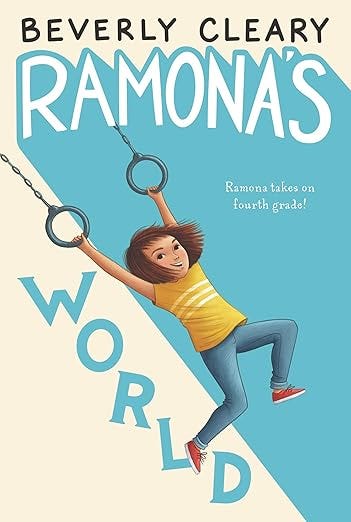
Beverly Cleary, Ramona's World
deep caves & folded wallet-papers

“‘He was a weird little fellow who grew up to be an interesting man, but at the time I wanted to dance with a tall, handsome boy.’”
If you were to ask me my favorite single piece of writing advice I’d probably mention Virginia Woolf’s diary entry about how she “dig[s] out beautiful caves behind her characters.”
And if you were then to say, That sounds neat, but can you give me an example of someone doing it?, I would walk you out of Classics and through Literature and across the hall into the sticky-floored, low-shelved realm of Children.
Specifically, I’d take you to book eight of Beverly Cleary’s Ramona series, and I’d turn to page 100. But before we take a look at what’s printed there, let me say something about the almost unreasonable goodness of these books.
Cleary, with Ramona, does the thing that every writer aspires to do but that almost no one manages: to make ordinary, deciding-what-to-have-for-dinner, watching-TV-commercials, staring-out-the-rainy-window-on-a-Sunday life feel like material enough. If someone gave Robert McKee the elevator pitch for the Ramona series (A girl grows up, and goes to the library, and sometimes wishes she had a different babysitter…), McKee would take that elevator to the roof and jump off. There are zero wizarding schools or secret powers or government agencies that for some reason need the help of a child. There isn’t even bullying, or puberty, or unusual familial agony. There is only a girl and her spectacularly vivid parents and siblings, living their unremarkable lives.
To get away with such mundanity, you need, of course, some compensatory offering. Nicholson Baker offsets his lack of incident with linguistically rich microscopy. Knausgård goes for hypnotic, punishing self-seriousness. And Cleary opts for the most audacious compensation of all: she writes characters so specific and true, so psychologically complete, that you forget that she’s even doing anything unusual. Plot, you realize reading Ramona, is how ordinary writers compensate for possessing sub-Cleary levels of insight into their characters.
Which brings me to page 100.
Ramona and her father have just driven Beezus — Ramona’s gawky and earnest older sister — to her first real middle school party. Beezus has been fretting for chapters about what she’ll wear and who she’ll dance with. Ramona’s been coming to understand, with uneasiness, that her parents worry about Beezus — that despite her formidability as Ramona’s sister, her social success is not assured. And now, with Beezus off at the party itself, a reflective quiet has settled over the Quimby house, as if Beezus were not on a dance floor but on an operating table.
When [Ramona and her father] returned home, Mrs. Quimby looked up from her book (she did not have many pages left) and said, as if her thoughts were far away, “I’ll never forget my first dance. It was in the school gym, and the only boy who asked me to dance I didn’t want to dance with. He was a weird little fellow who grew up to be an interesting man, but at the time I wanted to dance with a tall, handsome boy. Silly me.”
Note, first of all, the trusting, conversational complexity of Cleary’s prose. That first sentence — whose function is merely to steer us into the thicket of extended quotation — interrupts itself twice: first with a parenthetical (Mrs. Quimby’s been dutifully plodding through Moby-Dick for a book group), and then with a stage-direction (as if her thoughts were far away). And yet we’re never impatient, never confused. You know when you’ve kept a piece of paper in your wallet for so long that, when you take it out and unfold it, you discover that it’s turned almost into a kind of fabric? That’s how Cleary’s prose feels to me.
But the real marvel of the passage is Mrs. Quimby’s dialogue. I’ll never forget my first dance. This is the tone of someone staring off into the middle distance, someone communicating more with herself than with the family members in front of her. We are entering the cave that Cleary has carved out in back of Mrs. Quimby — the idiosyncratic, unknowably vast set of circumstances that have brought her to this moment as a middle-aged mother with a book in her lap.
Another step into the cave:
It was in the school gym, and the only boy who asked me to dance I didn’t want to dance with.
And then another:
He was a weird little fellow fellow who grew up to be an interesting man, but at the time I wanted to dance with a tall, handsome boy.
And with this sentence — my favorite in the book and quite possibly my favorite in the entire series — we fall reverentially still: our torches have illuminated a cave painting.
That phrase weird little fellow tells us that we are entirely within Mrs. Quimby’s private self; she would never be so rude about someone, not even a stranger, if she were playing the role of mother. And with her classmate’s transformation into an interesting man we experience the satisfying bewilderment of a high school reunion; how patiently and inventively life works on people.
But this is not Cleary providing a bit of adult service (like when the Minions screenwriters tuck some bit of innuendo into a scene to reward the chaperones for their perseverance). Because it isn’t just the reader who’s marveling at what we see in Mrs. Quimby’s cave — it’s Ramona too.
She is experiencing a childhood event no less momentous than a first boy-girl party: she is seeing her mother as a fellow planetary explorer, just a few years longer tenured than herself. She’s discovering that her mother’s life, her mother’s past, is not there to instruct her or to orient her, like the family tree at the front of Russian novel. No, her mother’s life, like her own life, is simply there, full of contingencies and embarrassments and secret thoughts. What if her mother had ended up with that weird little fellow? What if her actual father was just another weird little fellow? The implications are dizzying. Ramona scurries back the way she came, to the daylight of wondering how Beezus is doing and needing to go to bed.
But she is aware, now, of the network of caves that her creator (like the Creator) has carved out behind every person. Who needs wizarding school?
Smiled to myself the whole way through this. Thank you-
I've never read a book in this series, I may never. But this was an outstanding piece.