Louis Sachar, Holes
mercury drops & unwitting ancestors

“[He didn’t know he was Stanley’s great-great-grandfather.]”
Often I’ll be reading a new book to my daughter — something I’ve brought home from the library with great excitement — and the first couple of pages will go well enough. We’ll be acquainting ourselves with an unfamiliar set of characters, working up a slight cognitive sweat sorting out that this one is that one’s step-sister and that their conversation is taking place while they wait to see the headmaster at their prestigious but sinister boarding school.
And then, just as the sweat is drying and we’re finally beginning to move along at a gallop, confident that we now know the landscape’s salient features well enough to avoid twisted ankles, there will be a chapter break, and suddenly we’ll meet an entirely new set of characters, in an entirely different setting.
And it’s at this point — just as my reading voice has taken on a slightly desperate pep — that my daughter will interrupt with a forlorn Who? I’m not sure a book has ever recovered from that Who?
Because while I, grizzled veteran of who knows how many skirmishes with novels, know that this apparently unrelated set of characters will soon reveal themselves to be the first set’s adoptive parents or future roommates or whatever, she, whose scrupulously maintained book-list is still only in double-digits, can’t be convinced that the author has not suffered a cognitive event.
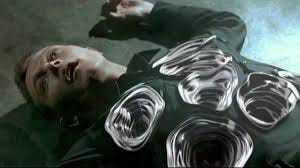
Which means that an entire species of literary pleasure is foreclosed to her. Specifically: the pleasure of watching discrete drops of narrative mercury congeal. This is what we enjoy in, say, Alice Munro’s “The Albanian Virgin” (Wait, the kidnapped woman was Charlotte!) or Infinite Jest (That miserable kid with the drunken father is Hal’s dad!). Around the turn of the millennium there was a mini-genre of movies whose frisson derived entirely from the plenitude of, and the distance between, mercury drops (Babel, Traffic, Magnolia, Crash).
Faced with such a narrative-diffusing novel, for a long time all I could do was assure my daughter that this was a thing that stories sometimes did and that she would someday come to like it (just as I assure her that adults are not in fact kidding when they listen to folk music). Then we tried Louis Sachar’s Holes.
Sachar is a genius at mercury-drop arrangement — and, just as importantly, he is a genius at building a platform from which the skeptical reader can actually see the drops in their state of pre-congealment trembling.
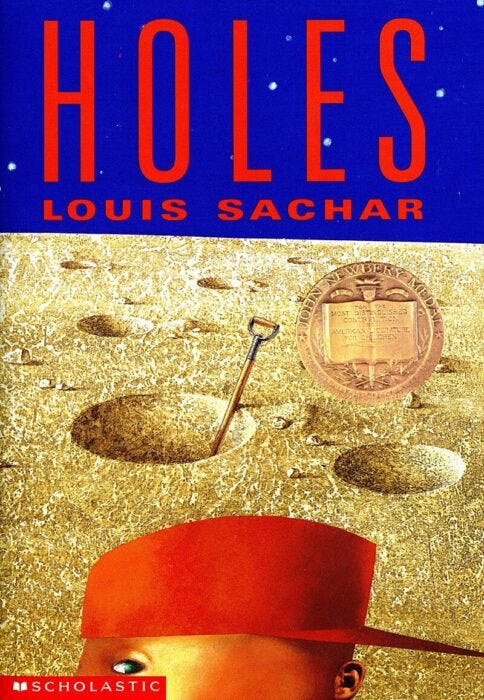
But first, in case you missed the fanfare and the (quite good!) Shia LeBeouf movie: Holes is a multi-award-winner from 1998 about a dystopian Texas camp where juvenile delinquents are forced to dig holes in the desert all day. And Sachar is the frisky, Kurt-Vonnegut-esque author of the Wayside School books, among many others. Holes is my favorite — and one of the best books I know for that occasionally barren interval (Graphic novels count as reading, right? Right??) between the family dinners of Beverly Cleary and the makeout sessions and terminal illnesses of John Green.
The first 26 pages unfold linearly enough: a boy named Stanley Yelnats is headed off to Camp Green Lake because he stole (or anyway was convicted of stealing) a pair of collectible sneakers. We learn a bit about Stanley — his loony, impoverished parents; his insensitive teachers — and we get a glimpse of Camp Green Lake in all its bleakness (“Those two trees were the only plant life he could see. There weren’t even weeds.”) We meet the oddball kids with whom he’ll be digging and the dopey, sadistic adults who’ll be overseeing them. The reader couldn’t be de-horsed if she tried.
But then, 27 pages and 7 chapters in, Sachar takes a risk. Having crafted a shapely and gleaming mercury droplet with this relatable boy arriving at a dreadful camp, he now places a second droplet, some distance away. There’s a page-break (he even inserts, into the page break, one of those floating, imposing em-dashes) and then he writes:
Stanley’s great-great-grandfather was named Elya Yelnats. He was born in Latvia. When he was fifteen years old he fell in love with Myra Menke.
And already I can feel the who? gathering in my daughter’s throat. Because these three sentences have so many things not going for them — the great-great litany that signifies that we are in a past so long-ago as to be scarcely picturable. The unfamiliar country. The new names Elya and Menke, with their Old World combinations of consonants and their wearying suggestion that we might soon be faced with a family tree. Sachar needs to do this — his ability to tell the real story of Camp Green Lake, and of Stanley’s true, family-redeeming purpose there, depends on it — but he is losing readers with every reverse-turn of the calendar page.
Sachar knows all this, of course, and so, before the who? can make it to my daughter’s lips, he adds this, in a paragraph of its own:
[He didn’t know he was Stanley’s great-great-grandfather.]
And suddenly we’re equipped not merely to tolerate but to enjoy the four-and-a-half page historical interlude that follows.
That bracketed sentence manages such a feat, first of all, because of its brackets. Those rarely-used punctuation marks — the industrial-strength alternative to parentheses — invite the reader backstage; they create a distinct, narrating self; they indicate that we are not alone in this (briefly bewildering) stream of events. Yes, this is a brand new mercury drop, but look, here I am with my pipette.
And the content of the sentence — its footnote-esque tone of clarification — amounts to a frank acknowledgment of the reader’s distress. Approaching it I feel like a diner at a restaurant, credit card in hand, looking around with mounting alarm for a disappeared waiter — and then, like an old world maître d’, Sachar appears table-side to assure us that our server will be with us shortly. I know you don’t know who these people are, the sentence says. Well, I know who they are. And they themselves don’t!
That mildly trippy twist — the reminder that our ancestors went about their lives under the misimpression that they were protagonists in their own right, not knowing that they were merely the means of creating the true protagonist who is us looking back at them — is the sentence’s final delight. The egotism that comes with being a self is both underscored and lightly teased.
And before we know it, before we have even remembered to suffer, the new mercury drop has leapt into — has been miraculously swallowed up by — the orb of the original. Our confusion has disappeared; our capacity for delight has grown.
I love the mercury drop metaphor. It's exhilarating when we begin to pull the drops together on our own, recognizing the patterns and seeing the plot unfold in new ways. I love the look on children's faces as they listen to a book being read aloud and experience the mercury drops merging and coalescing. Thanks for writing about Holes. It's a terrific book.
Tim Robinson as your daughter being faced with multiple narratives almost made me choke on my granola bar. Hilarious. And I've already checked the library. I'm getting this book today. Thanks as always!